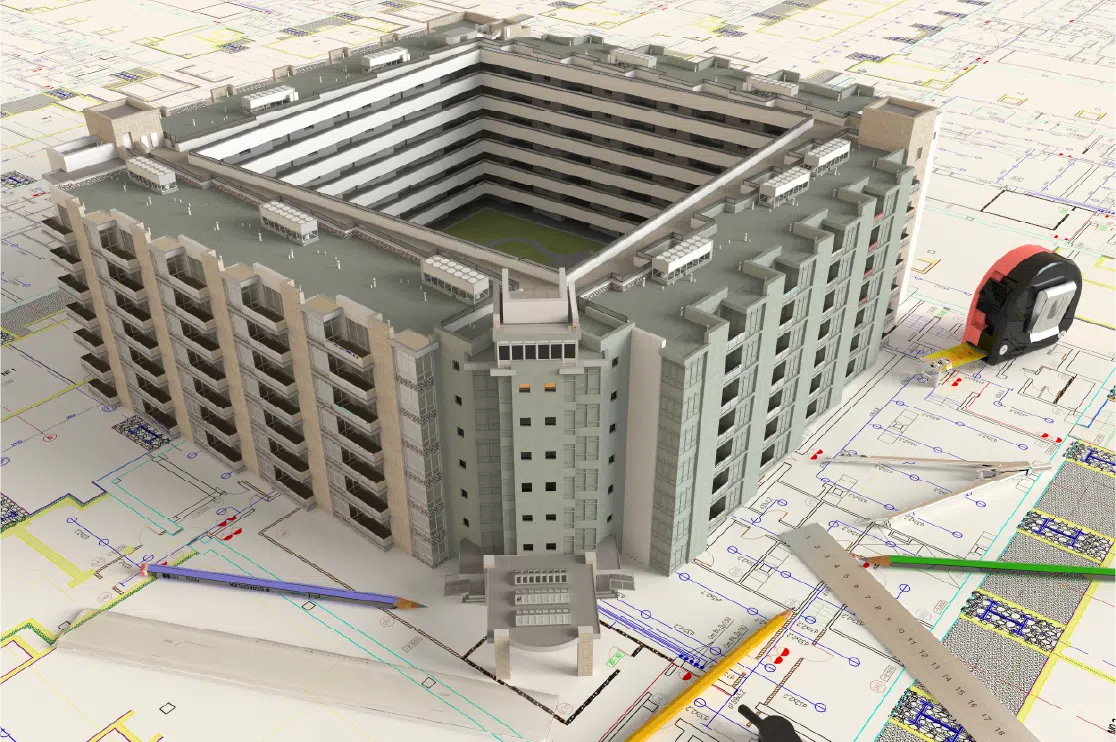
Hand sketches to CAD to 3D to BIM … and now what’s next in the AEC industry? It’s BIM 2.0.
From drawing lines to generating complete 3D smart models, cloud-based softwares and AI in construction design are already changing how architects work.
Tools are pushing firms to invest in digital momentum even as adoption lags in some corners of the industry (Source: Bluebeam Industry Outlook 2026)
You can feel both excitement and caution at the same time.
Despite these ongoing advances, architects still feel that updated BIM software showcase signs of stagnation. Progress and innovation are still not at pace as compared to other industries.
This has led to inception of new generation of BIM software, which is BIM 2.0.
Let’s break down what BIM 2.0 is, how it differs from traditional BIM, where it’s already useful, and why the industry is talking about it.
Table of Contents:
What is BIM 2.0?
BIM 2.0 is the new generation of BIM software that offers a unified view of all the systems in one cloud-enabled space.
You won’t need any separate software for architectural, structural or MEP coordination. Everything will be done under one roof. Also, it will be AI-enabled, which will make it sync easily with the latest tech updates and offer great power to AEC teams.
Challenges of Traditional BIM
Traditional BIM comes with two main challenges.
Fragmented Workflows
Even though BIM was meant to bring teams together, most projects still rely on multiple tools across different stages. One platform for architectural modeling (Revit, Rhino), another for coordination (Navisworks), another for analysis, and more for cost or scheduling.
Information moves between systems, but context often gets lost.
Updates take time. Teams work in parallel, not truly together. What was meant to be collaborative ends up fragmented.
Slow Innovation at High Costs
Most CAD and BIM tools were built long before internt, AI and SAAS became standard. While vendors like Autodesk release yearly updates, subscription costs have increased faster than meaningful innovation.
This directly impacts the pricing that architects offer for their services.
But, real reason is that these updates often focus on incremental features rather than fundamental workflow changes. While other industries are rapidly integrating AI, automation, and real-time data, BIM platforms have largely stayed model-centric.
Architects feel this gap most during early design stages, where tools still feel rigid instead of exploratory.
Need for BIM 2.0 – From Fragmented BIM to Unified BIM
These challenges don’t mean BIM has failed. No, Never, not at all.
In fact, they highlight that the industry has outgrown the way BIM tools were originally designed.
Projects move faster now. Critical decisions are expected much earlier. Teams want real-time collaboration, not delayed coordination spread across disconnected platforms.
For example- In industry design or product design, everything from design to production is carried out on one single unified platform. AEC teams are now looking for the same kind of setup in building construction such as tools like Micro and Figma. One BIM environment that supports the entire journey, from early design to construction, operations, and lifecycle management.
Some other drivers of BIM 2.0 include –
-
Better data integration and intelligence
-
Deeper, real-time collaboration across teams
-
Stronger focus on sustainability and performance
-
Automation and optimization of repetitive and complex tasks
To meet these new demands, the focus is shifting from isolated tools to connected systems. That shift is what the industry now calls BIM 2.0.
Features of Building Information Modeling 2.0
According to Architizer, the features that are expected in BIM 2.0 must follow future AEC specification software.These include –
1. Unified & Universal Data Framework
A single, universal data framework that all AEC tools can read from and write to. This allows transparent, consistent, and efficient data exchange across platforms, teams, and project stages.
2. Seamless Access
Unlike the desktop-based software, BIM 2.0 supported software will offer live access of data, geometry and construction documentation to all AEC teams.
3. Designing in Context and at Any Scale
Design decisions can be made and evaluated in real time, whether at the component level or the city scale. Context is no longer stripped away during early design or coordination phases.
4. Modern, User-Centered Experience
The focus shifts to tools that are intuitive, efficient, versatile and flexible. BIM 2.0 prioritizes usability, so teams spend less time managing software and more time designing and deciding.
5. Intelligent Modeling Capabilities
Modeling moves beyond geometry. Accuracy, flexibility, level of detail, and embedded intelligence increase, allowing models to support analysis and automation.
6. Responsible Design Enablement
BIM 2.0 supports responsible and sustainable design decisions by making performance data available earlier and easier to evaluate.
7. Support for MMC and DfMA Approaches
Modern Methods of Construction and Design for Manufacture and Assembly are built into construction documentation workflows, not treated as add-ons or late-stage exercises.
8. Automation and AI at Scale
Automation is native, not scripted as a workaround. BIM 2.0 enables AI-driven processes that can scale responsibly across projects and portfolios.
9. Smarter Deliverables
Deliverables are no longer static outputs. They are intelligent, data-rich, and reusable across construction, operations, and asset management.
10. Improved Access, Data Ownership, and Licensing
Commercial models evolve to offer better access to data, clearer ownership, and more flexible licensing, reducing friction for teams and clients alike.
BIM 2.0 Vs Traditional BIM
To really understand BIM 2.0, you have to see it side by side with traditional BIM.
| Aspect | Traditional BIM | BIM 2.0 |
|---|---|---|
| Primary drivers | Large, legacy software vendors | Startups solving real workflow pain |
| Core focus | Detailed modeling and documentation | Feasibility, early design, and decisions |
| Stage of impact | Mid to late design | Early-stage design and planning |
| Software architecture | Desktop-first, file-based | Cloud-native, platform-based |
| Collaboration | Limited, milestone-driven | Real-time, multi-user collaboration |
| User experience | Complex, production-oriented | Intuitive, designer-friendly |
| Innovation speed | Slow, incremental updates | Rapid, user-driven iteration |
| Cost structure | High subscriptions, vendor lock-in | Flexible, value-based pricing |
| Data flow | Fragmented across tools | Centralized and interoperable |
| AI integration | Minimal or external | Native and workflow-driven |
| Automation | Scripts and workarounds | Built-in and scalable |
| Creativity support | Constrained by tools | Enhanced through exploration |
| Examples | Revit, Navisworks | Snaptrude, Arco, Giraffe, Finch, Speckle |
The Truth – Will BIM 2.0 Replace BIM?
One big question arises: “Will BIM 2.0 replace Revit or Rhino”?
Well, the truth is. No, they won’t. While BIM 2.0 addresses many gaps in traditional BIM, it is still evolving.
Most BIM 2.0 platforms are early-stage products and are not yet full replacements for established tools. Today, they work best alongside existing BIM software, mainly during feasibility and early design.
There is also a heavy focus on automation in early stages, which raises questions around creativity. Speed is valuable, but architects are still figuring out how to balance AI-driven efficiency with design control.
Finally, building a full-scale BIM platform is complex. Core modeling depth, data interoperability, and industry trust take time to develop. BIM 2.0 is moving in the right direction, but it is still a work in progress.
Let’s give them a chance to grow.
Stay tuned for part-2 of this series where we’ll be covering major startups and platforms that are working on BIM 2.0 and their features.
Recommended Reads:
Conclusion
While BIM 2.0 is still evolving, the direction is clear: cloud-first workflows, AI-assisted design and indeed a stronger focus on early-stage impact.
Being a leading BIM company USA, BluEnt stays ahead of these shifts. By combining the latest BIM technologies with deep industry experience, we deliver high-quality, reliable BIM services to teams across the globe.
FAQ
What is BIM 2.0 in architecture?BIM 2.0 refers to the next generation of BIM software that is cloud-based, collaborative, and focused on early design, feasibility, and decision-making rather than just documentation.
Is CDE and BIM 2.0 same or different?A CDE (Common Data Environment) is a centralized place to store, manage, and share project information where BIM works. Whereas, BIM 2.0 is all about new advanced software that uses advanced features such as CDE and offers an integrated workflow.CDE manages data, BIM 2.0 uses data to drive decisions.
Why is BIM 2.0 emerging now?Slow innovation, rising subscription costs of existing software and fragmented workflows in traditional BIM tools have pushed AEC industry to look for more integrated and flexible solutions.
Is BIM 2.0 meant to replace Revit or Rhino?No, not immediately. Most BIM 2.0 tools currently complement existing software and are mainly used during feasibility and early design stages.
Why do most BIM 2.0 tools focus on early-stage design?Early design and feasibility are time-consuming and often underpaid phases. BIM 2.0 tools aim to speed up massing, planning, and reporting where faster decisions matter most.
How does AI fit into this new Building Information Modeling?AI is used to generate design options, automate layouts, check regulations, and assist architects during early design rather than replacing creativity.






 Point Cloud to BIM or CAD: Which Workflow Is Right for Brownfield Facility Projects?
  Biggest BIM Mistakes That Cause Construction Projects to Fail and How to Avoid Them
  CAD-to-BIM vs Scan-to-BIM: Which is Best for Existing Buildings?
  9 Best BIM Software Tools in 2026: Features, Ratings and Expert Picks