The five core barriers to BIM adoption – cost, skills gap, interoperability, workflow disruption, and culture – with specific strategies for small and mid-size AEC firms.
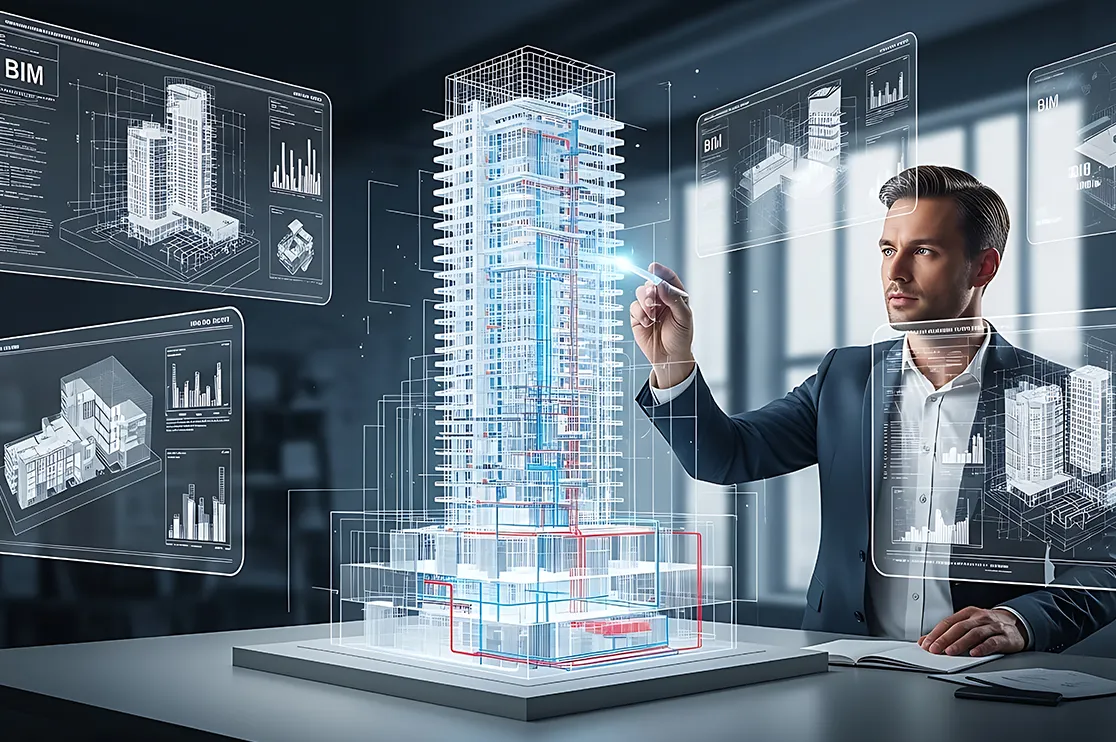
AEO Definition: BIM Construction Technology BIM construction technology is the process of creating and using intelligent 3D building models that store structured data about every component, geometry, materials, specifications, cost, schedule, and maintenance requirements, and keeping that data coordinated across all project disciplines in real time. Unlike CAD drawings, which represent what a building looks …
The state of BIM in the US in 2026, who has mandated it, which sectors lead adoption, what the BIM hangover really means, and where the market is heading. Data-backed, sector-by-sector analysis for AEC professionals.
Discover how BIM for commercial construction helps developers, contractors, and architects reduce project risks in new builds and commercial renovations.
Four firms are working on the same project. The lead architect is ArchiCAD. The structural engineer uses Tekla Structures. The MEP engineer runs MagiCAD on top of Revit. The facilities manager’s asset system expects data in a spreadsheet format it can import. In a closed BIM workflow, this project starts with software negotiation. Someone converts …
There is a misconception that BIM is meant only for large projects with complex geometries. With the right preparation and strategic planning, however, the adoption of BIM can be swift and effective for small firms.
The ‘vs’ Framing Is the Wrong Question A project manager calls and asks for CAD drawings. Your firm runs Revit. You spend two days exporting DWGs, stripping out the model’s intelligence in the process, and delivering flat geometry that the contractor immediately prints and marks up by hand. Meanwhile, a residential architect switches to Revit …
Artificial Intelligence in construction design has significantly disrupted and transformed conventional approaches. Be it optimizing and automating workflows or resource planning and fault/error detection,
The building and construction sector accounted for 37% of process and energy-related CO2 emissions in 2021, according to the UN’s 2022 Global Status Report for Buildings and Construction.
Let’s be honest for a second. You’ve signed off on a project, the designs are locked in and now you are starting to see the budget slip.
Connect with us!
Let's Talk
"*" indicates required fields