





What Is BIM Consulting?
BIM consulting is the provision of expert guidance, coordination, and technical services to help AEC firms plan, implement, and manage Building Information Modeling workflows on projects or across their organization. A BIM consultant may write the BIM Execution Plan, manage the federated model, run clash detection, train staff, select and configure software, or scope a firm’s BIM implementation roadmap. BIM consulting is distinct from BIM modeling: a modeler creates model geometry; a consultant shapes the process, standards, and coordination that make that geometry useful.
An architecture firm wins a BIM-required contract. The project manager has a Revit license. Nobody on the team has written a BIM Execution Plan, managed a federated model, or run a clash detection meeting.
The owner’s BIM requirements run 47 pages. The deadline is six weeks. This is the most common scenario in which firms hire a BIM consultant, not as a strategic choice, but as an emergency response.
The better approach is to understand what BIM consulting covers before you need it urgently. A BIM consultant is not a Revit drafter. The scope is broader, and the value is higher.
This guide covers what BIM consultants actually do, when external consulting makes more sense than building an internal BIM team, and what to look for when selecting a BIM consulting firm.
Table of Contents:
What Is BIM Consulting? What BIM consulting covers, how it differs from BIM modeling, and why most firms need it on demand rather than permanently
BIM consulting exists because BIM implementation involves decisions that go beyond software. Which platform for which project type? What Level of Development at each phase? Who owns a clash resolution? What does the handover model need to contain? These decisions determine whether a BIM implementation delivers value or just creates expensive files.
Most small-to-mid-size AEC firms do not have the internal capacity to answer all these questions for every project. A BIM consultant brings that capacity on demand, scoped to the project, not carried out as a permanent overhead.
BIM consulting services vary significantly in scope. Some firms provide strategy-only engagements (BIM readiness assessments, platform selection, and BIM Execution Plan authoring). Others provide embedded project support (BIM coordination, clash detection management, model auditing). BluEntCAD provides both.
Bring Your Projects to Life with Expert BIM Services
BluEntCAD delivers expert BIM services, including Revit modeling, BIM coordination, clash detection, scan-to-BIM, 4D scheduling, and 5D cost estimation, to streamline project delivery.

Download Brochure
Share a few details to access the commercial rendering brochure and learn more about our solutions.
Bim Brochure
What Does a BIM Consultant Actually Do?
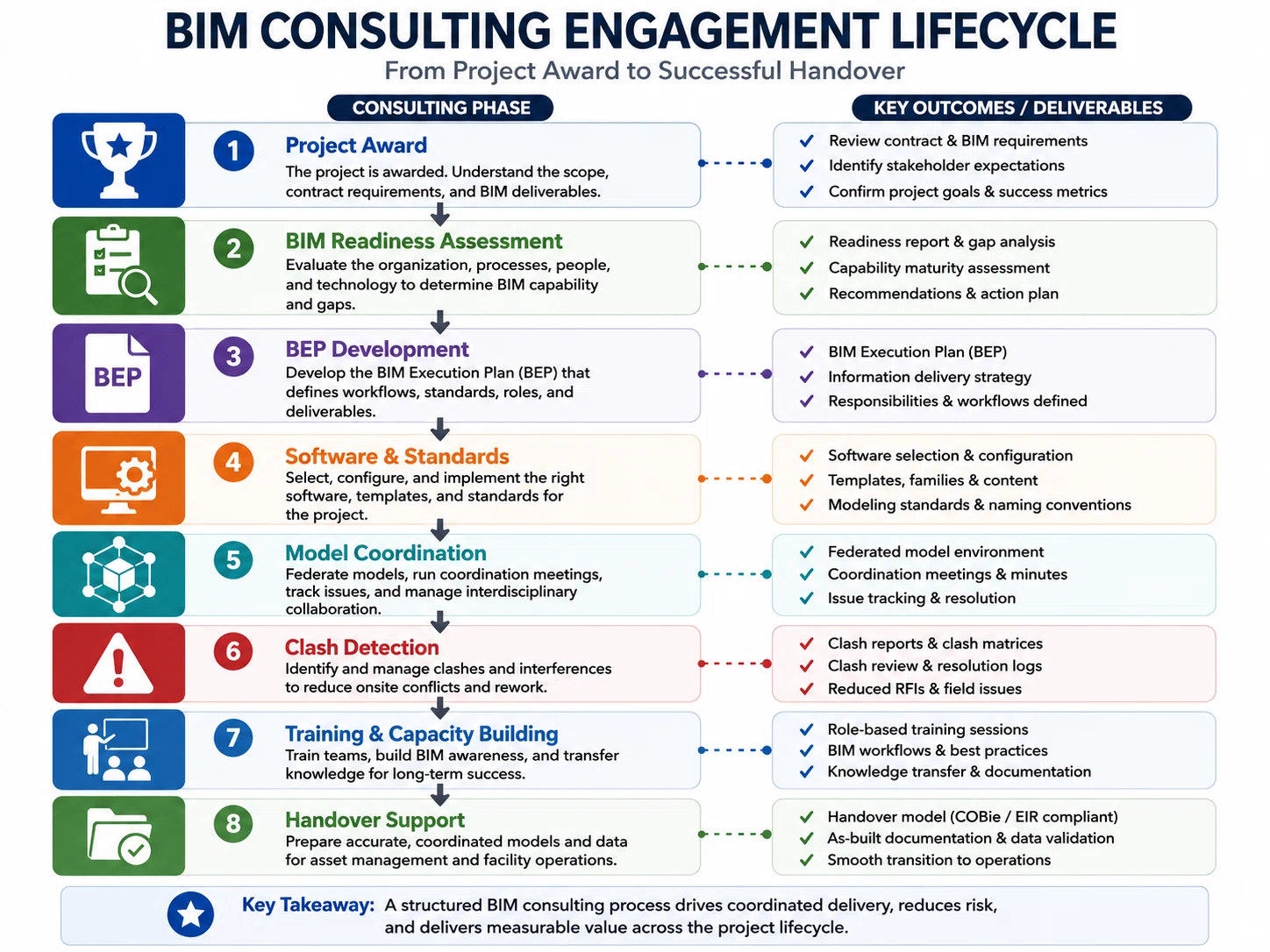
The scope of BIM consulting depends on where a firm is in its BIM maturity and what the project requires. The most common services fall into six categories.
BIM Execution Plan (BEP) Development
The BEP is the governance document for BIM on a specific project. A BIM consultant writes the BEP, gets discipline lead sign-off, and ensures compliance. Without a BEP, coordination fails; different naming conventions, mismatched coordinate systems, and inconsistent LOD expectations create model conflicts that cost more to resolve than the BEP would have cost to write.
Model Coordination and Clash Detection
The BIM consultant federates discipline models (architectural, structural, MEP) in Navisworks or Solibri, runs clash detection, manages the issue log, assigns clashes to responsible parties, and tracks resolution. This is the service most often provided on an ongoing project basis, typically weekly or bi-weekly through the design and pre-construction phases.
BIM Implementation Roadmap
For firms transitioning to BIM for the first time, a consultant assesses current workflows, recommends software (Revit, ArchiCAD, Vectorworks), specifies hardware, defines firm-level naming conventions and template standards, and scopes a phased adoption plan. This is strategy work, not modeling.
Software Selection and Configuration
BIM platform decisions are consequential and difficult to reverse once a team is trained, and projects are underway. A consultant evaluates options against the firm’s project mix, team skills, client requirements, and budget, and configures the chosen platform with standard templates, shared parameter files, and project browser structures.
Staff Training and BIM Standards Development
A BIM consultant may deliver Revit or Navisworks training, develop internal BIM standards documentation (the firm’s BIM manual), and establish quality control checklists for model review. The objective is to build internal capability that reduces dependence on external consulting over time.
Handover Model Preparation
For projects where the client requires an FM-ready handover model, with COBie data, equipment asset registers, and maintenance schedule information, a consultant scopes and manages the data population process during construction, ensuring the model is usable at handover rather than rebuilt from scratch post-completion.
A BIM consultant is not there to model the building. They are there to ensure the model is built the right way, so it can be used for coordination, estimation, and handover.
BIM Consulting vs. Internal BIM Team: How to Decide How to decide whether external consulting or building internal BIM capacity makes more sense for your firm
The question of external consulting versus internal BIM capacity is a resourcing decision, not a quality decision. Both approaches can deliver excellent results. The choice depends on project volume, firm size, and the type of BIM work required.
When external BIM consulting makes more sense:
-
Project-specific requirements (a single BIM-mandated contract that does not represent ongoing project type)
-
Specialized capability the firm does not have internally (Scan to BIM, COBie data management, IFC coordination)
-
Surge capacity during busy periods when the internal coordinator is fully allocated
-
Strategic engagements (BIM readiness assessment, platform selection, BEP authoring for a new project type)
When building internal BIM capacity makes more sense:
-
BIM is a consistent requirement across most of the firm’s projects
-
The firm has volume to justify dedicated BIM coordinator headcount
-
Long-term standardization goals require embedded capability, not project-by-project consulting
Warning: The most expensive BIM strategy is also the most common one: hiring a BIM consultant to produce BIM deliverables on each project without ever building internal capability. This creates permanent dependency on external support with no knowledge transfer. If you use BIM consulting, build knowledge transfer into the engagement scope, not as an afterthought.
| $1.85T | Autodesk and FMI estimate that poor-quality data cost the global construction industry approximately US$1.85 trillion annually through rework, delays, inefficient decision-making, and lost productivity. Structured BIM consulting helps improve project coordination, documentation, and information management, reducing many of the risks associated with poor-quality project data. Source: Autodesk / FMI Corporation, 2020. |
|---|
Need expert BIM consulting for your next project?
BluEnt provides BIM consulting services for AEC firms across the US, UK, Canada, & Middle East from BIM Execution Plan authoring to embedded project coordination and clash detection management.
When to Hire a BIM Consultant: Six Specific Triggers Six specific project and organizational situations that signal it is time to bring in outside BIM expertise
Your project contract requires BIM deliverables your team cannot produce.
A BIM-mandated public sector or institutional project with an Employer’s Information Requirements (EIR) document is the clearest trigger. The EIR specifies exactly what BIM deliverables are required, and if your team cannot produce them, a consultant can.
You need a BIM Execution Plan and have never written one.
A BEP is a specific technical document. The first one a firm writes typically takes 20-40 hours with appropriate expert input. A consultant can produce this and use it as the basis for a firm-standard BEP template.
You are responsible for model federation and clash detection on a complex project.
If your project has 6+ discipline models and weekly coordination meetings, embedded BIM coordination support, running Navisworks, managing the issue log, chairing coordination meetings, is a standard BIM consulting engagement.
You are evaluating BIM software for the first time.
Platform decisions made without expert input are frequently reversed at significant cost. A short BIM readiness assessment and platform selection engagement pays for itself by avoiding a wrong-platform adoption.
Your handover model does not meet client requirements.
FM-ready handover models require COBie data, asset registers, and structured maintenance information, none of which are generated automatically by modeling in Revit. A consultant can assess what is missing and scope for the population process.
Your BIM implementation has been installed.
A firm that bought Revit licenses but is still doing most work in CAD has a people and process problem, not a software problem. A BIM consultant can diagnose the stall and scope a recovery plan.
What to Look for in a BIM Consulting Firm
Not all BIM consulting firms offer the same scope. Here are five criteria that distinguish competent BIM consultants from software vendors masquerading as consultants.
Demonstrated project coordination experience
A BIM consultant should be able to show examples of federated models they have managed, clash reports they have produced, and BEPs they have authored, not just software certifications.
Platform-agnostic advice
A consultant who recommends only one BIM platform regardless of your project mix has a vendor relationship, not a consulting relationship. The right platform depends on your project types, team skills, and client requirements.
Clear scope and deliverable definition
BIM consulting engagements should have a defined scope: specific deliverables, timelines, and success criteria. Vague engagements produce vague results. Ask for a scope of work before signing anything.
Knowledge transfer built into the engagement
The best BIM consultants make themselves progressively less necessary over the course of an engagement by training your team and documenting standards. If a consultant’s approach creates permanent dependency, that is not a consulting model; it is a staffing model.
Industry-specific experience
BIM coordination on a hospital project requires different knowledge than BIM on residential development. Confirm that the consultant has relevant experience in your project type.
Recommended Reading:
What BIM Consulting Does Not Cover (Honest Limitations)
BIM consulting does not replace discipline modelers.
A BIM coordinator federates and coordinates discipline models. The models themselves are created by architects, structural engineers, and MEP contractors. If discipline teams are not modeling, or modeling incorrectly, consulting cannot fix that without direct intervention in the authoring workflow.
BIM consulting cannot fix a missing BIM Execution Plan retroactively.
A consultant hired after modeling has started cannot enforce naming conventions, coordinate origins, or LOD requirements on work that is already done. The earlier in a project a consultant is engaged, the more value they can add.
BIM consulting does not guarantee on-site coordination.
A clash-free BIM model is not a clash-free building. Model coordination identifies conflicts in the design. On-site construction deviations, late design changes, and un-modeled elements create coordination issues that BIM cannot prevent after construction mobilization.
Warning: The most common unrealistic expectation of BIM consulting: ‘The consultant will handle the BIM, so we don’t have to think about it.’ BIM coordination requires active participation from discipline leads, submitting current models on schedule, attending coordination meetings, and resolving assigned clashes in their authoring software. A consultant manages the process; the team does the work.
Scoping a BIM Consulting Engagement: Next Steps
BIM consulting is most valuable when engaged before the deadline, before modeling starts, before the BEP is needed, before the coordination meeting that nobody is prepared to run.
The right consulting scope depends on where your firm is in its BIM maturity: a readiness assessment and platform selection for a firm new to BIM, embedded coordination for a project already underway, or handover model preparation for a project approaching completion.
BluEntCAD provides BIM consulting services for AEC firms across the US, from BIM Execution Plan authoring to ongoing clash detection management and handover model preparation.
Ready to Scope Your Next BIM Project?
Get in touch with our BIM consultants to discuss your project requirements and explore a consulting engagement tailored to your goals, timeline, and delivery needs.
Common Questions
What does a BIM consultant do?A BIM consultant provides expert guidance on BIM workflows, standards, and coordination, typically including BIM Execution Plan authoring, model federation, clash detection management, software selection, staff training, and handover model preparation. The scope varies by engagement: some are project-specific (ongoing clash detection management), others are strategic (platform selection, BIM readiness assessment). A BIM consultant shapes the process; the discipline teams create the model of geometry.
When should a firm hire a BIM consultant vs. build an internal BIM team?External consulting is the better choice when BIM requirements are project-specific, when the firm needs specialized capability, it does not have internally (COBie data management, IFC coordination), or when surge capacity is needed without permanent headcount. Internal BIM capacity makes more sense when BIM is a consistent requirement across most projects, and the firm has enough volume to justify a dedicated BIM coordinator role. The key is to avoid permanent external dependency without knowledge transfer.
How much does BIM consulting cost?BIM consulting fees vary widely depending on scope, from a short BIM readiness assessment to an embedded full-project coordination engagement spanning months. Ask for a scoped proposal with specific deliverables rather than an hourly rate, as the latter makes it difficult to budget the engagement.
What is included in a BIM Execution Plan?A BIM Execution Plan (BEP) is the governance document for BIM on a specific project. It typically covers project BIM goals, software and file format standards, naming conventions, coordinate systems, Level of Development requirements by phase, model author responsibilities, clash detection protocols, and handover model requirements. A BEP produced by a consultant on project one can serve as the basis for a firm-standard BEP template used on subsequent projects.
What is the difference between a BIM consultant and a BIM coordinator?A BIM coordinator is typically an embedded project role, managing the federated model, running clash detection, and tracking issue resolution on a specific project. A BIM consultant may perform BIM coordination but also provides strategic services: BIM readiness assessments, platform selection, BEP authoring, and firm-level BIM standards development. In practice, the terms overlap, and many firms use them interchangeably.
How do you evaluate a BIM consulting firm before hiring them?Ask examples of BEPs they have authored, clash reports they have produced, and federated models they have managed, not just software certifications or client lists. Confirm they are platform-agnostic (not recommending one vendor regardless of your project mix), that their engagements include defined deliverables and timelines, and that knowledge transfer to your team is built into the scope. Industry-specific experience in your project type is a material differentiator.
About Authors

Sampath Kumar Boddhula

Sampath is an architect with over two decades of international experience delivering residential, commercial, and hospitality projects. He specializes in design documentation, project delivery, and establishing standards-driven workflows that improve accuracy, efficiency, and consistency. With extensive experience leading multidisciplinary teams across the US, Canada, Singapore, New Zealand, and India, he combines technical expertise with strategic leadership to ensure high-quality project execution, regulatory compliance, and operational excellence.

Rimmi Jain
Rimmi is a Technical Content Consultant with over a decade of experience creating content for the Architecture, Engineering, and Construction (AEC) industry. With expertise in BIM, CAD, and 3D visualization, she transforms complex engineering concepts into clear, engaging content that supports business growth. Combining technical knowledge with SEO strategy and AI-assisted workflows, she helps AEC brands strengthen their online authority through accurate, insightful, and search-optimized content.





 How to Choose a BIM Outsourcing Company: A Vendor Scorecard
  BIM for Airport Projects: How BIM Supports Complex Aviation Infrastructure
  Do You Really Need a BIM Execution Plan for Every Construction Project?
  Why Choose BIM for Educational Facilities and School Construction and Management Projects?