





Being a manufacturer, someone sends you a drawing for a staircase railing. You open it expecting clear instructions, but instead you see only where the railing sits in the building.
No weld notes. No hole size. No material thickness. Nothing that tells you how to actually make it. At that point, you’re stuck.
Do you start fabricating based on assumptions?
Do you call the contractor for missing details?
Do you wait for another drawing?
And while everyone figures it out, the project slips into:
-
More confusion & chaos
-
Delays
-
Rework
-
Higher cost
-
Unnecessary frustration
The same confusion happens the other way around, when a contractor receives fabrication drawings instead of shop drawings.
This usually happens because there’s confusion between shop drawings and fabrication drawings. Both are crucial in architectural, structural and MEP projects, but they’re not interchangeable.
So, let’s break down what each one means, who uses it and when, and how they fit into the construction process. Let’s take up all these with an example, to make things crystal clear.
Shop Drawings and Fabrication Drawings Meaning
Before beginning with the difference, let’s take a quick look into what exactly these technical drawings mean. Let’s build clarity first.
What are Shop Drawings?

Shop drawings are construction drawings that showcase how the components will fit in the architectural perspective on site. The focus lies on installation and coordination within the overall design.
Shop Drawings Example
Consider it in this way. Staircase shop drawings that will clearly showcase all the installation and assembly details of the proposed design of the staircase.
They’ll show where the base plate sits, how the railing & balusters connect to slab edge, treads & riser dimensions, alignment with walls, headroom clearance and so on.
Even things like anchor sizes, grout notes, mounting height, access gaps for maintenance and any coordination required with electrical or HVAC elements nearby are clearly mentioned.
It isn’t about how to manufacture every bracket or tread. It’s about how everything fits when installed on site.
Why are shop drawings important?
AEC industry deeply relies on construction shop drawings as they help align architectural and structural plans for compatibility and coordination.
These build a clarity between design intent and their on-site implementation. Without them, both the fabrication team and the installers would be guessing their way through the project, which can compromise accuracy and safety.
What are Fabrication Drawings?
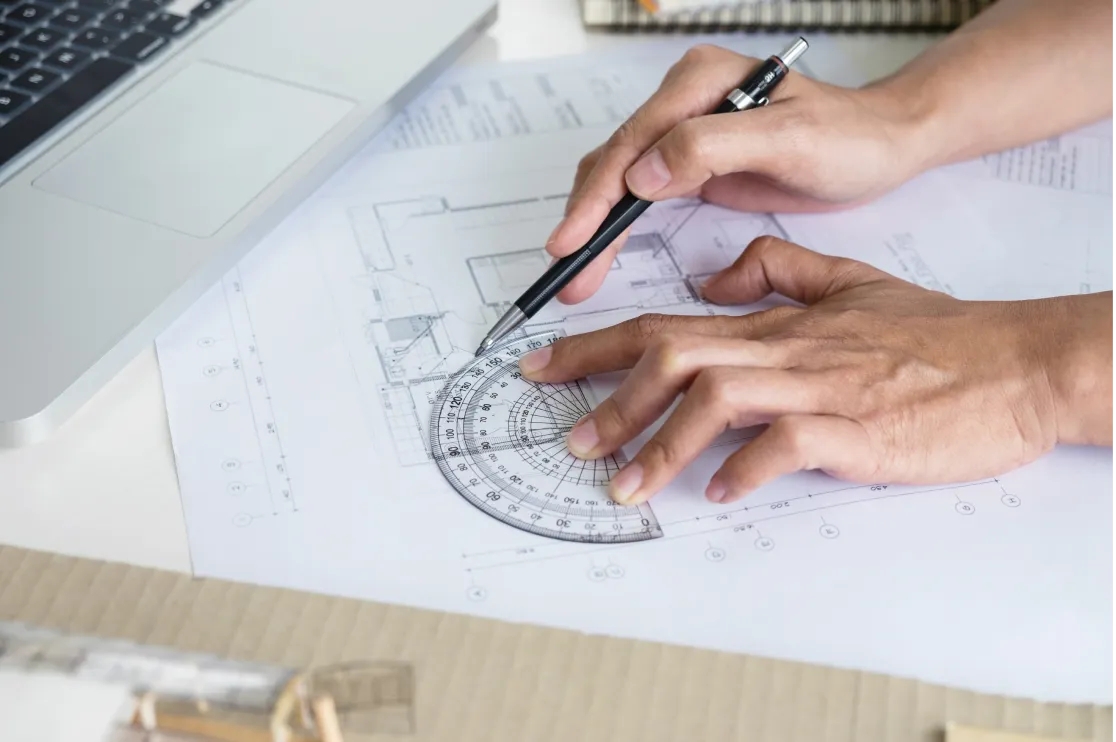
As the name suggests, fabrication drawings tell deeper level detail required for manufacturing a component in assembly facility or manufacturing shop.
Fabrication drawings are usually created after the design and shop drawings are approved. So, there’s no risk of manufacturing something that doesn’t fit on site.
Fabrication Drawings Example
Now look at the same staircase from a fabrication point of view. Here, the drawing isn’t about where the staircase goes onsite. It’s about how each part will be made in the workshop.
You’ll see specifics like a tread plate sized 950 mm x 280 mm, with Ø12 mm holes spaced 100 mm center to center, a 4 mm riser sheet bent at 90°, and a note calling for a 6 mm continuous fillet weld.
It goes into thickness, hole positions, bending radius, finish and tolerances. The fabricator should be able to pick this drawing and manufacture the part without asking a single question.
In simple terms, the architectural design says, “the staircase will go here,” the shop drawing explains “this is how it will be installed and coordinated with everything around it,” and the fabrication drawing tells “this is exactly how each part will be made in the factory.”
Why are Fabrication Drawings Important
Simple. Without clear fabrication drawings, the workshop is left interpreting the design, which leads to inconsistencies, wasted material, rework and delays. Accurate fabrication drawings mean:
-
Predictable results
-
Faster production
-
Fewer errors
-
Smoother installation
-
Lower cost
With professional fabrication drawings, the components arrive on site ready to be installed.
Shop Drawings Vs Fabrication Drawings – Getting Things Clear
So, let’s understand the difference between shop drawings and fabrication drawings through this comparison table.
| Shop Drawings | Fabrication Drawings | |
|---|---|---|
| Other names | technical drawings, installation drawings, prefabrication drawings, working drawings | Detail drawings, assembly drawings, welding drawings, structural fabrication drawings, MEP drawings |
| Purpose & Function | Shop drawings show how a component will be installed on site and how it fits with the overall design. Thus, catering a broader context. | Fabrication drawings have all the deeper level details that show how a particular component will be manufactured or assembled in a factory or a workshop. |
| Level of Detail | Construction shop drawings are moderately detailed. They include material specs, dimensions, installation instructions, coordination with other systems such as electrical, plumbing, HVAC. | Fab drawings are highly detailed and precise. These include information on precise cuts, bolt sizes, weld symbols, hole location, tolerances, finishes, material treatment, machining requirement, assembly sequence etc. |
| Where used | On-site | Workshop, assembly facility or factory |
| Audience | Architects, engineers, General contractors, engineers, construction and installation teams | Fabricators and welders, manufacturing teams, Machine operators, prefabricated systems suppliers, QA inspectors |
| Creation & Workflow | Shop drawings are created by contractors, sub-contractors or detailing companies. They are produced during construction phase of the project. And use structural and architectural construction drawings as their base. | Fabrication drawings are made by fabricators, vendors or manufacturers after shop drawings are made and approved. These drawings guide the production on the shop floor. |
| Software and Standards | Revit, AutoCAD and other BIM (Building Information Modeling) tools are used to produce clash free drawings aligned with codes and project standards. | Advanced CAD (computer aided designing) and CAM (computer aided manufacturing) tools are used to generate fabrication shop drawings to ensure they comply with ANSI, AWS etc. standards. |
| Compliance | Must match approved design drawings, contract specifications and authority approvals. | Must follow tolerances, QA requirements and shop drawing approvals without deviation. |
| Example | Staircase shop drawing showing anchor bolt alignment, railing position, slab interface and clearances. | Same staircase broken into parts showing tread plate size 950 x 280 mm, hole Ø12 mm @ 100 mm c/c, 4 mm riser bend and 6 mm continuous weld instructions. |
Note For complex projects, both shop drawings and fabrication drawings are used. One guides installation, the other guides manufacturing. Together they prevent mistakes and seal project success.
How to Choose Right – Shop Drawings or Fabrication Drawings

With all above information, we hope it’s easy for you to decide on which construction drawings to choose for your project. Just think about these two questions in mind and you’ll get the answer.
-
The stage of the project
-
Your specific requirements
If you need guidance for installation and coordination on site, you’re looking for shop drawings.
If you need precise details to manufacture a component, you’ll need fabrication drawings.
Read More:
Ensuring Accurate Shop Drawings and Fabrication Drawings
To get accurate and high quality fabrication drawings or shop drawings, it’s very essential to
-
Get in touch with CAD drafting service providers as early as possible
-
Prefer BIM-integrated workflows to ensure coordinated and clash-free construction drawings
- Hire experienced and expert CAD drafters to get best shop drawings and fabrication drawing services
With BluEnt as your construction drawings company partner, we offer best architectural working drawings and fabrication drawings services that
-
Minimize errors
-
Reduce delays
-
Clear communication between stakeholders
Schedule a call today and share with us your requirements and learn how our team can help you get the best construction documentation services.
Frequently Asked Questions
Are shop drawings and fabrication drawings the same?No. Shop drawings explain how a component will be installed on site, while fabrication drawings focus on how that component will be manufactured in a workshop.
Who prepares shop drawings?Shop drawings are usually prepared by contractors, subcontractors or detailing teams based on the approved architectural design and construction documents.
Who prepares fabrication drawings?Fabrication drawings are typically prepared by fabricators, vendors or manufacturers after shop drawings are approved. You need to approach a professional CAD drafting company to get things done accurately and of high quality.
When are shop drawings required?Shop drawings are required during the construction or installation stage to ensure everything aligns correctly with the architectural and structural intent.
When do you need fabrication drawings?Fabrication drawings are needed once the architectural design is finalized and approved. These are required to ensure every component is manufactured as per the specs and make it ready to install for on-site installation.
What happens if fabrication starts without approved fabrication drawings?This can lead to misalignment, rework, wasted material, safety issues and cost overruns.
Do shop drawings include weld symbols and machining information?Usually, no. Shop drawings focus on installation and fit, while weld symbols, machine cuts and tolerances belong in fabrication drawings.





 What are Types of Fabrication Drawings, and Why Are They Necessary for Your Project?
  What’s the Difference Between Shop Drawings vs Construction Drawings vs As-Built Drawings
  AutoCAD And RFMS: Find the Perfect Fit for Your Tile & Stone Shop Drawing Projects
  Exploring the Array of Tile & Stone Shop Drawing Services: Choose Your Right Solution