





The short answer: with BIM staff augmentation, vendor modelers join your team and work under your direction, usually at a monthly rate. With project outsourcing, you hand a defined scope to a vendor, who manages and delivers it for a project price. Augmentation suits steady, ongoing work where you want to control. Outsourcing suits clear, one-off scopes where you want the vendor to carry out the delivery risk.
Your team has more BIM work than people to do it.
Hiring takes months. Overtime burns people out. Turning work away hurts the business.
So, you look outside, and you make a choice. Do you add outside modelers to your own team? Or hand whole projects to a vendor?
Both work. But they suit different situations, and picking the wrong one costs time, money, and patience.
Table of Contents:
- What is BIM staff augmentation?
- What is BIM project outsourcing?
- How do BIM staff augmentation and project outsourcing compare?
- When does BIM staff augmentation make sense?
- When is the BIM project outsourcing the better choice?
- What does a hybrid BIM model look like?
- What should you ask for a BIM partner before signing?
- How do you make an augmented BIM team?
- Frequently asked questions
- Ready to add BIM capacity?
What is BIM staff augmentation?
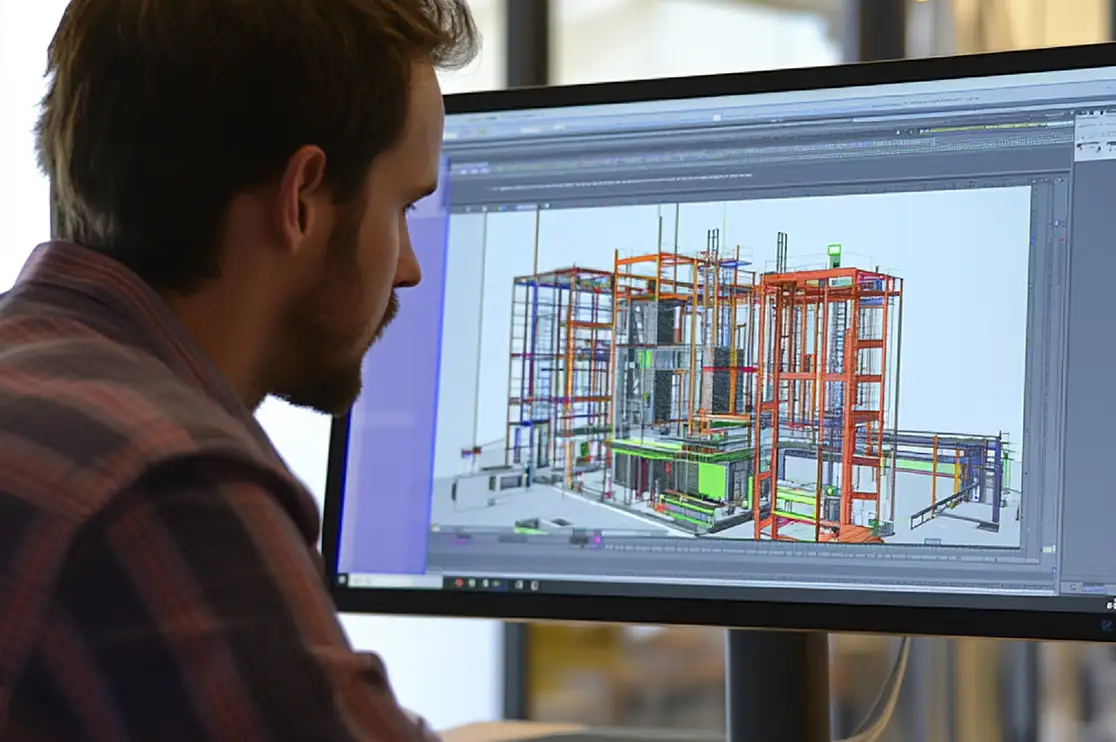
BIM staff augmentation means adding a vendor’s modelers to your own team.
They work on your projects, to your standards, under your BIM manager. You decide what they work on each week. The vendor handles hiring, payroll, equipment, and replacements.
You usually pay a monthly rate for each person. That’s why it’s often called a dedicated BIM team.
Bring Your Projects to Life with Expert BIM Services
BluEntCAD delivers expert BIM services, including Revit modeling, BIM coordination, clash detection, scan-to-BIM, 4D scheduling, and 5D cost estimation, to streamline project delivery.

Download Brochure
Share a few details to access the commercial rendering brochure and learn more about our solutions.
Bim Brochure
What is BIM project outsourcing?
BIM project outsourcing means handing a defined piece of work to a vendor.
You agree with the scope, the level of detail, the deadline, and the price. The vendor plans the work, manages its own team, and delivers the results.
You pay per project, per sheet, per square foot, or by the hour. You review the output, but you don’t manage the people doing it.
How do BIM staff augmentation and project outsourcing compare?
| Factor | Staff augmentation | Project outsourcing |
|---|---|---|
| Who manages the work | You | The vendor |
| Who carries delivery risk | Mostly you | Mostly the vendor |
| How you pay | Monthly rate per person | Per project, sheet, square foot, or hour |
| Best for | Steady, ongoing volume | Clear, one-off scopes |
| Your management time | Higher: daily direction | Lower: reviews and milestones |
| Flexibility | Easy to redirect week to week | Changes need a scope change |
| Knowledge kept | Builds up in a stable team | Depends on the vendor’s team |
When does BIM staff augmentation make sense?

Staff augmentation tends to work best when:
-
You have steady BIM work for months ahead, not just one project
-
Your priorities change often and you want to redirect people quickly
-
You have a BIM manager with time to direct the extra modelers
-
You want people who learn your standards and stay, so quality improves over time
-
You’d hire, but can’t find or wait for the right people
When is the BIM project outsourcing the better choice?
Project outsourcing tends to work best when:
-
The work is a clear, one-off scope, such as modeling an existing building
-
You want budget certainty and a fixed delivery date
-
Your team has no time to manage extra people
-
You need skills you don’t have in-house, for a limited time
-
You want the vendor to carry the risk if it takes longer than planned
Related read:
What does a hybrid BIM model look like?
Many firms end up using both.
A small dedicated team handles steady, everyday work. When a large or specialist project lands, it goes out as a defined project. When it’s done, nobody needs to be let go.
This gives you a stable core that knows your standards, plus room to absorb peaks without long commitments.
What should you ask for a BIM partner before signing?

Whichever model you choose, ask these questions up front:
-
Continuity: if someone leaves or is unavailable, how quickly are they replaced, and who trains the replacement?
-
Ramp-up: How long until the team is productive on your standards?
-
Working hours: How many hours overlap with your working day?
-
Ownership: Who owns the models, files, and IP once you’ve paid?
-
Security: Is there a confidentiality agreement, and who can access your files?
-
Exit terms: How much notice is needed to scale down or stop?
-
A trial or pilot project: Can you start with a small piece of work before committing?
Our BIM services USA page explains how we approach delivery for US firms.
How do you make an augmented BIM team?
An augmented team is only as good as its onboarding. These steps make the difference:
-
Share your BIM template first. Families, title blocks, naming, and view settings. If your template is thin, Revit family creation can fill the gaps before the team starts.
-
Share your BIM execution plan, or a short note on how models are built, checked, and shared.
-
Give access to the tools, file storage, and issue tracker your team already uses.
-
Name one point of contact on each side.
-
Hold a short weekly check-in on priorities and quality.
-
Start with a trial period on real but low-risk work.
Ready to add BIM capacity?
At BluEnt, you don’t have to pick a vendor for each model. We take on fixed-price projects, and we provide dedicated teams at a monthly rate for continuous volume. Every account has a named coordinator as your single point of contact. Many clients start with a small pilot batch before committing, and there’s no minimum contract for fixed-price work.
Frequently asked questions
Is BIM staff augmentation cheaper than project outsourcing?It can be when the work is steady, because you’re paying for the capacity you use every week. For a single, well-defined project, a fixed project price is often simpler and avoids paying for idle time.
How quickly can an augmented BIM team start?It depends on the vendor and the skills you need. Ask for a start date in writing and allow time for the team to learn your template and standards.
Who owns the BIM work an outside team produces?You should once you’ve paid. Make sure the contract says so for models, files, and any families or templates created for you.
Can we switch from project outsourcing to a dedicated team later?Yes. Many firms start with a single project or a small trial, then move to a dedicated team once the volume and the working relationship are proven.







 BIM Pricing Models Explained: Per Sheet, Per Sq Ft, Hourly, or Fixed Price
 Renovating Live Hospitals with BIM: Infection-Control Phasing and MEP Shutdowns
 How BIM for Stadiums De Risks Multi Million Dollar Sports Infrastructure Projects
 What to Send a BIM Vendor to Get an Accurate Quote

