





New data center construction demand is soaring globally with forecasts projecting nearly 100 GW of new capacity by 2030.
The major catalysts for data center demand include AI, cloud, big data and IOT adoption.
Construction spending could exceed $1 trillion by 2030, led by hyperscalers racing to deploy new facilities at scale. But the rush comes with real challenges. Energy constraints, labor shortages, tight timelines and pressure to prove ROI are making data center projects more complex than ever.
This is where BIM for Data centers changes the game.
From power dense layouts and cooling coordination to clash-free MEP design and faster permitting, BIM helps teams plan, build and operate data centers with far greater certainty.
Read on to see why BIM is becoming essential for modern data center construction.
Why Data Center Construction Is Experiencing a Surge?

In any case, this surge isn’t going to stop. Reason?
Businesses are generating more data than ever, and old facilities simply cannot keep up. Hyperscalers are now building faster, bigger and smarter data centers to stay competitive, while governments and enterprises are racing to secure future ready infrastructure.
According to Research and Markets, data center construction is growing at a pace the industry has never seen before, with North America currently leading the league. The key drivers include:
-
Cloud and digital data explosion
-
AI is changing infrastructure needs
-
Edge computing is going mainstream
-
Global expansion beyond the US and Europe
-
Energy and sustainability pressure
To meet these growing demands, BIM for data centers enables end to end control across the data center lifecycle, from planning and design to construction, commissioning and operations.
Certainly, helping teams deliver faster, smarter and more reliable facilities.
Challenges in Modern Data Center Construction Projects
Building a data center today is not just about space and servers. It is a high-risk, high complexity engineering exercise.
-
Teams must design for extreme electrical loads and power redundancy while managing energy availability and carbon targets.
-
Thermal and airflow management becomes critical as rack densities rise and cooling margins shrink.
-
Fast track construction schedules leave little room for rework, yet any clash between structure, MEP and IT systems can delay commissioning by months.
-
Add labor shortages, security requirements and strict uptime expectations, and the pressure to deliver ROI becomes intense.
This is exactly where a BIM-led approach for data center construction projects becomes essential.
BIM-driven Approach for Data Center Construction
Here’s how BIM for data centers actually supports construction on the ground.
Design Coordination and BIM Integration
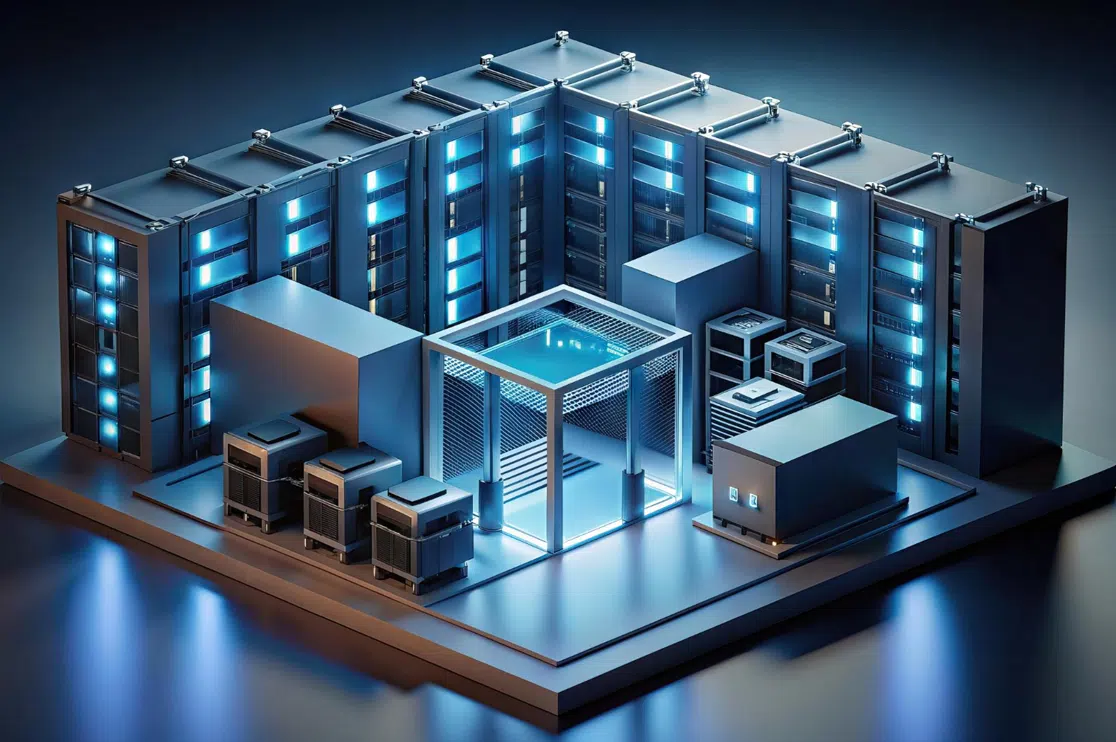
A federated 3D BIM model for data center construction brings architecture, structure and MEP into one environment. This eliminates the blind spots.
Clear coordination between architectural, structural and MEP elements resolve clashes between ducts, cable trays, busways and cooling systems before they reach site.
How BIM clash coordination helps?
-
Reduces RFIs and rework
-
Zero schedule & overbudgeting risk
-
Space is optimized for rack layouts & service corridors
-
Future expansion becomes easy
4D & 5D BIM for Better Predictability and ROI
Data center construction demands strict schedule adherence and tight cost management. 4D BIM and 5D BIM integrate time and cost data with the 3D model, enabling teams to plan, monitor and control project execution with higher accuracy.
It enables data center teams to:
-
4D BIM or Construction Sequencing – By linking the 3D model with the project schedule, teams can see how the data center will be built step by step and fix issues before work starts on site.
-
Cost control with 5D BIM – Quantities are pulled directly from the model and connected to cost data, which makes budgets more reliable and changes easier to manage.
-
Risk reduction – When schedule and cost are visible early, clashes, rework and material waste drop significantly.
BIM for Data Center’s Thermal, Airflow and Energy Modeling
Cooling systems consume a major share of data center energy. Do you know, even small airflow errors can lead to hotspots and equipment failure.
BIM for data centers combined with CFD analysis helps teams evaluate and validate airflow across hot and cold aisles and optimize cooling layouts early. Now, this ensures:
-
better temperature control
-
lower energy use
-
longer equipment life
-
Supports sustainability
Thus, helping data centers to stay efficient as demands grow.
BIM for Data Center Asset Management and Operations
Do you know what’s the best part? After construction, the same 3D BIM model becomes a digital twin for operations and facility management. It stores asset data, maintenance schedules and system details, which is structured through COBie for smooth handover.
Higher dimensions of Building information modeling for data centers helps the facility teams and owners in:
-
Quickly locating equipment
-
Tracking service history
-
Planning upgrades
-
Improving maintenance efficiency
-
Reducing downtime
Read More:
BIM Data Centers for Reducing Carbon Emissions
Do you know one of the biggest sustainability advantages of BIM for data center construction projects? It helps reduce carbon emissions before construction even starts. BIM allows teams to study energy use, cooling demand, and material impact at the design stage, when changes are still easy and low cost.
It helps project teams and owners to:
-
Analyze energy consumption and cooling efficiency early using BIM based performance modeling
-
Optimize airflow and HVAC systems through coordinated, clash free BIM models
-
Reduce material waste and control cost with 5D BIM cost estimation and accurate quantity takeoffs
-
Evaluate low carbon materials and renewable energy options during the design stage
Thus, enabling facility managers to track operational carbon performance across building lifecycle and make data center future ready.
Recommended Reads:
BluEnt – Your Reliable & Honest BIM Partner for Data Center Projects
Whether you are planning to revamp an existing facility or deliver a new Data Center project, BluEnt has the expertise to deal with technical and operational nuances of such critical infrastructure. With two decades of rich experience, we have supported countless large-scale, confidential projects across the globe.
With BluEnt, as your BIM services provider, you get
-
Fully coordinated and clash-free architectural, structural, and MEP models
-
4D scheduling and 5D cost estimation services
-
World-class Team of BIM experts working on advanced BIM software
-
Deeper understanding of local standards and regulations
Apart from this, our advanced BIM services help you get a sustainable and low-carbon-emission data center faster, safer and more efficient.
We support architects, engineers, contractors, and owners by converting design intent into coordinated construction-ready BIM and CAD models across data center lifecycle.
Final Words
AI and cloud computing are shaping the future, and the demand for data centers is only going to grow.
BIM for data center gives owners a facility that performs reliably throughout its lifecycle, from construction to operations. By supporting prefabrication, improving coordination, enabling better sequencing and cost control, and strengthening long term asset management, BIM brings real value beyond design.
At BluEnt, we deliver tailored and comprehensive BIM solutions for data center projects at every stage, from early design to upgrades and optimization.
Frequently Asked Questions
How does BIM help in data center construction?BIM helps teams plan and build data centers in a more coordinated way. It reduces clashes, avoids delays and makes construction faster and safer.
Can BIM be used for existing or brownfield data centers?Yes, BIM works for both new and existing data centers. It is commonly used for revamping facilities, capacity expansion and system upgrades.
Is BIM useful only in the design stage?Not really. BIM supports the full lifecycle of a data center, from early planning and construction to operations and maintenance.
How does BIM reduce delays and rework on site?By finding clashes early and planning construction sequences in advance, BIM helps avoid last minute changes and site level confusion.
Can BIM help reduce carbon emissions?Yes. BIM helps improve energy planning, cooling efficiency and material usage, which helps lower the overall carbon impact of a data center.
Is BIM an expensive investment for data center projects?It may need some investment upfront, but it saves a lot of time and cost later by reducing errors, rework and delays.






 Why Choose BIM for Educational Facilities and School Construction and Management Projects?
  Point Cloud to BIM or CAD: Which Workflow Is Right for Brownfield Facility Projects?
  Biggest BIM Mistakes That Cause Construction Projects to Fail and How to Avoid Them
  CAD-to-BIM vs Scan-to-BIM: Which is Best for Existing Buildings?