





If you are a Construction Executive or a BIM Director, you have probably been in this situation. You know Building Information Modeling makes projects smoother and you have seen it catch clashes before they happen on site. But when the CFO asks, “What’s the actual quantifying BIM benefits for our bottom line?” do you have the numbers ready?
For years, the industry has relied on a gut feeling that BIM is beneficial. But in today’s economy, gut feelings don’t win bids or justify software investments. We need core data. We need a framework that translates digital coordination into dollars that are saved.
This blog breaks down how to measure BIM value effectively, moving beyond theory into practical, research backed methods that resonate with the way we build in the USA.
Table of Contents:
- Why Quantifying BIM Benefits is the New Industry Standard
- A Research Backed Approach to BIM Value Measurement
- Real World Construction ROI Lessons from Case Studies
- Calculating Your Investment Rate and Operational Savings
- Conclusion Turning Data into Decisions with BluEnt
- Frequently Asked Questions FAQs
Why Quantifying BIM Benefits is the New Industry Standard
The days of adopting BIM just because it is trendy are now over. We are in the era of tighter margins and labor shortages. According to recent industry reports, poor coordination and rework can cost contractors up to 10 percent of total project costs. This is where quantifying BIM benefits becomes your strongest tool.
It is not about proving that BIM works. It is about showing how much it works. By establishing clear metrics, you can identify which phases of your project lifecycle from design to demolition are delivering the highest returns.
This clarity helps you make smarter decisions about where to invest your technology dollars next.
A Research Backed Approach to BIM Value Measurement
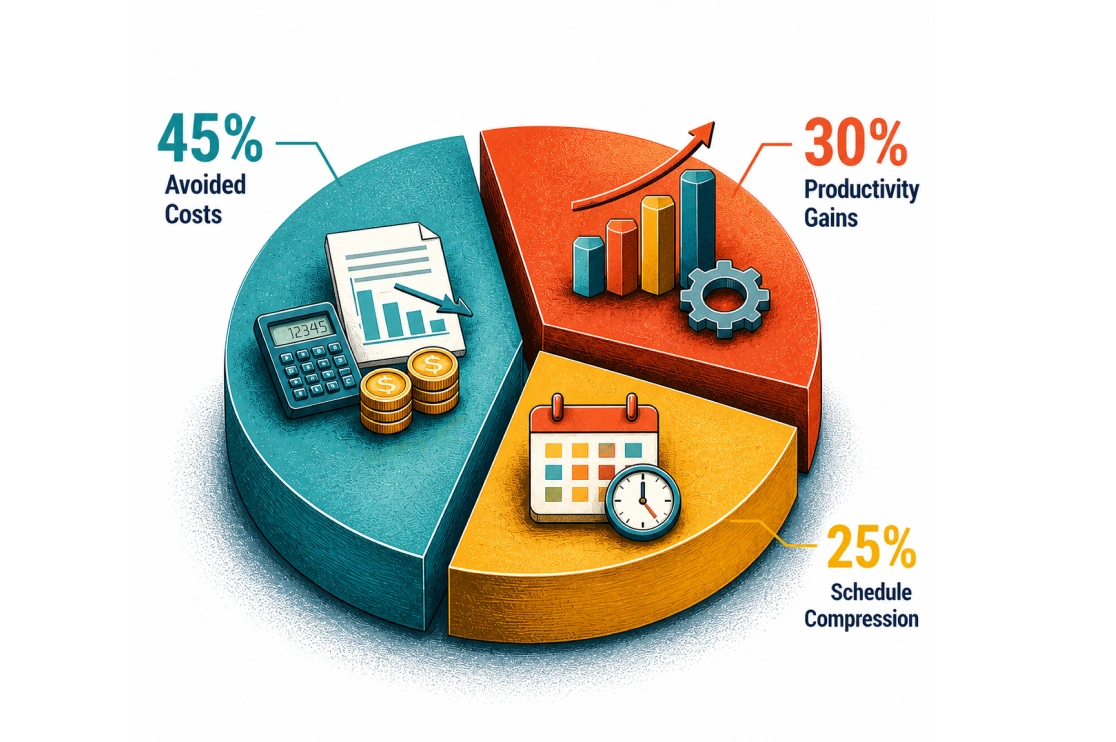
As it is said, you cannot manage what you do not measure, a solid methodology for BIM value measurement focuses on three key areas that matter most to construction firms.
WHERE BIM SAVINGS COME FROM
-
Focus on avoided costs by tracking clashes caught in the model before they hit the field. Fixing issues in Revit saves thousands in on-site rework like cutting concrete or rerouting ductwork.
-
Measure productivity gains by tracking hours saved through automated quantity takeoffs versus manual calculations. Faster, more accurate estimates mean your team bids more jobs and wins more work.
-
Analyze schedule compression by measuring how 4D BIM sequencing reduces project timelines. Shorter schedules lower your costs and get clients into their buildings faster, building loyalty and repeat business.
In summary, by comparing projects that used traditional methods against those using integrated BIM workflows, you start to build a portfolio of proof. This evidence becomes your strongest sales tool for winning new business.
Recommended Reading:
Real World Construction ROI Lessons from Case Studies
Real world case studies prove that earlier BIM integration drives bigger savings. On a typical commercial build, poor coordination triggers an RFI spiral that slows work and delays deadlines. Firms using strong BIM protocols see RFIs drop significantly because teams spend less time waiting and more time building.
One key lesson from a complex healthcare project we have taken is here: With clash detection and detailed shop drawings, the team saved hundreds of coordination hours and handed over a hospital month early. On a hospitality project, constant room layout changes that once took weeks were completed in days using BIM, getting the hotel open for peak season.
Calculating Your Investment Rate and Operational Savings
Investment analysis must cover the full building lifecycle, not just software and training costs. The real returns come during operations when the BIM model becomes a digital twin for facility managers. They access valve locations, warranty data and part numbers instantly, turning BIM into a long-term asset management tool. But let’s be clear: digital twins require ongoing data maintenance. Without regular updates, the model loses its value over time.
Quantify these operational benefits realistically. If facility teams keep the twin current and fix maintenance issues in half the time, those savings compound over decades. A commercial building with complex HVAC systems proves the point. Instead of hours spent hunting for manuals, managers pull up the updated model, order the exact part, and solve problems fast. That is BIM value measurement that extends far beyond construction but only when the data stays alive.
Recommended Reading:
Conclusion Turning Data into Decisions with BluEnt
Quantifying BIM benefits does not have to be a mystery. It takes disciplined data collection, clear methodology, and the right partners. By focusing on clash prevention, productivity metrics, and lifecycle value, you can build an undeniable business case for advanced BIM adoption.
At BluEnt, we help you capture that data. With over 80,000 successful projects, we understand the US construction market and the specific challenges you face every day.
-
We streamline your processes. Our BIM services including scan to BIM, Revit modelling, and clash detection help commercial architects, general contractors, and subcontractors turn complex coordination into clear measurable savings.
-
We work as your extension. We serve medium to large commercial, hospitality, and residential clients across the United States with 24/7 support, quick turnarounds, and a three-step quality check process.
-
We deliver results. Industry leaders like Beazer Homes trust BluEnt because we understand that your success depends on delivering projects on time and on budget.
Ready to quantify your BIM benefits? Connect with BluEnt to uncover precise cost savings, improve project transparency, and make data-driven decisions.
Frequently Asked Questions FAQs
How do I start quantifying BIM benefits on an ongoing project?Begin by tracking key metrics from this point forward. Log every clash detected, every RFI avoided, and every hour saved in material takeoffs. Compare these against similar past projects to establish a baseline for savings. Even a few months of data can tell a compelling story.
What is the easiest win for construction ROI BIM?Clash detection wins every time. Catching a major MEP clash in the model costs virtually nothing to fix but catching it in the field can cost tens of thousands in demo and rework. It is the most direct and provable saving you will find.
How does BIM improve operational efficiency after construction?The as-built BIM model acts as a digital manual. Facility managers can instantly locate assets, access maintenance schedules, and order exact replacement parts. This capability drastically cuts down on building operational costs and reduces downtime when systems fail.
Can small to mid-sized contractors afford BIM?Yes absolutely. You do not have to build an in-house mega team. By partnering with experienced BIM service providers like BluEnt, you gain access to top tier talent and technology on a flexible project by project basis. This makes BIM cost savings analysis immediately accessible without the overhead of full-time hires.
How long does it take to see real savings from BIM?Most firms see measurable results within the first six months of implementing proper BIM workflows. The key is starting with clear metrics and tracking them consistently. Some savings like clash detection appear immediately while others like operational benefits accumulate over time.







 Do You Really Need a BIM Execution Plan for Every Construction Project?
  Why Choose BIM for Educational Facilities and School Construction and Management Projects?
  Point Cloud to BIM or CAD: Which Workflow Is Right for Brownfield Facility Projects?
  Biggest BIM Mistakes That Cause Construction Projects to Fail and How to Avoid Them