




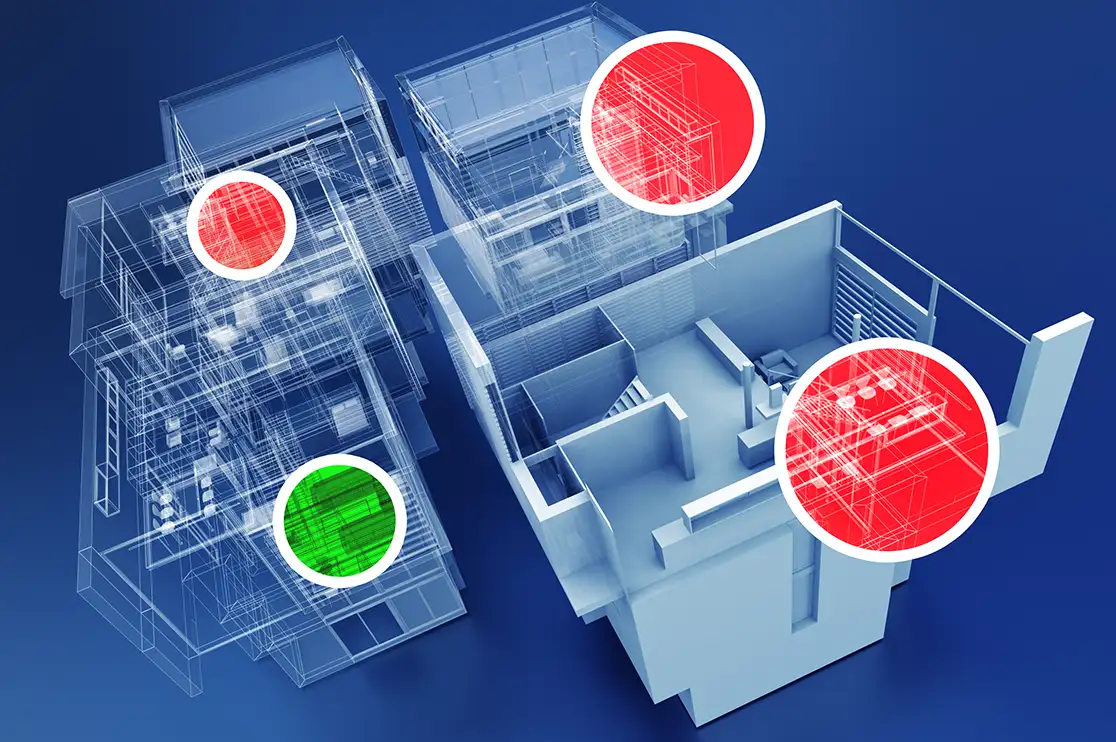
The short answer: keep the decisions in-house, and hand out the production work. Your team should run coordination meetings, decide who moves what, and sign off coordinated areas. An outsourced BIM team can collect and check trade models, federate them, run clash tests, group the results, and prepare reports, so your coordinator walks into every meeting ready.
It’s 11 pm on a Monday. Your coordination meeting starts at 9 tomorrow morning.
The mechanical model arrived an hour ago. Your only VDC coordinator is still federating models, running clash tests, and building the report. On two other projects.
Sound familiar? Many general contractors have more coordination work than coordinators. The question isn’t whether to get help. It’s which parts to hand out, and which to keep.
Table of Contents:
- What does BIM coordination involve on a GC’s project?
- Which BIM coordination tasks should a GC keep in-house?
- When does outsourcing BIM coordination make sense?
- When should BIM coordination stay fully in-house?
- How do you outsource BIM coordination without losing control?
- What should you ask for an outsourced BIM coordination partner?
- How is outsourced BIM coordination priced?
- Frequently asked questions
- Ready to take the pressure off your VDC team?
What does BIM coordination involve on a GC’s project?

On most projects, BIM coordination follows the same cycle, week after week:
-
Collect the latest models from each trade.
-
Check them: right location, right naming, right level of detail.
-
Federate them, which means combining all trade models into one model, usually in Navisworks.
-
Run clash tests to find where systems collide or crowd each other.
-
Group and assign the clashes, so each issue has an owner.
-
Meet with the trades to agree to fixes.
-
Track each issue until it’s closed and repeated.
Some of this need judgment and authority. Much of it is careful, repeatable production work. That split is the key to outsourcing.
Bring Your Projects to Life with Expert BIM Services
BluEntCAD delivers expert BIM services, including Revit modeling, BIM coordination, clash detection, scan-to-BIM, 4D scheduling, and 5D cost estimation, to streamline project delivery.

Download Brochure
Share a few details to access the commercial rendering brochure and learn more about our solutions.
Bim Brochure
Which BIM coordination tasks should a GC keep in-house?
| Task | Who should own it | Why |
|---|---|---|
| Running coordination meetings | Keep in-house | Needs authority with the trades |
| Deciding who moves what | Keep in-house | Affects cost, schedule, and contracts |
| Signing off coordinated areas | Keep in-house | It’s your risk on site |
| Talking to the owner and design team | Keep in-house | It’s your relationship |
| Tracking issues to closure | Shared | Partner updates, your team chases |
| Collecting and checking trade models | Can outsource | Repeatable process work |
| Federating models | Can outsource | Technical, time-consuming |
| Running clash tests | Can outsource | Rules-based, easy to standardize |
| Grouping clashes and preparing reports | Can outsource | Turns raw clashes into a usable agenda |
| Updating models after decisions | Can outsource | Where the partner also models |
The pattern is simple. Anything that needs a decision, a relationship, or a signature stays with you. Anything that turns files into a clear, meeting-ready picture can go out.
Related read:
When does outsourcing BIM coordination make sense?

Outsourcing tends to pay off when:
-
You’re running several projects at once with one or two VDC staff
-
Your workload has peaks, such as several projects entering coordination together
-
You need reports ready before every meeting, without late nights
-
Some trades can’t model their own systems and need modeling support
-
You want your coordinators doing site and trade work, not file processing
When should BIM coordination stay fully in-house?
Keeping everything in-house can be the better call when:
-
One very large project has a full VDC team on site
-
The contract requires on-site coordination staff
-
The project has strict security rules about where files can go
-
Your team has the capacity, and the process already works
Or see how our BIM clash detection services work.
Want to see what a meeting-ready clash report looks like?
Ask us for a sample BIM clash report and issue log and see how we’d prepare your coordination work.
How do you outsource BIM coordination without losing control?
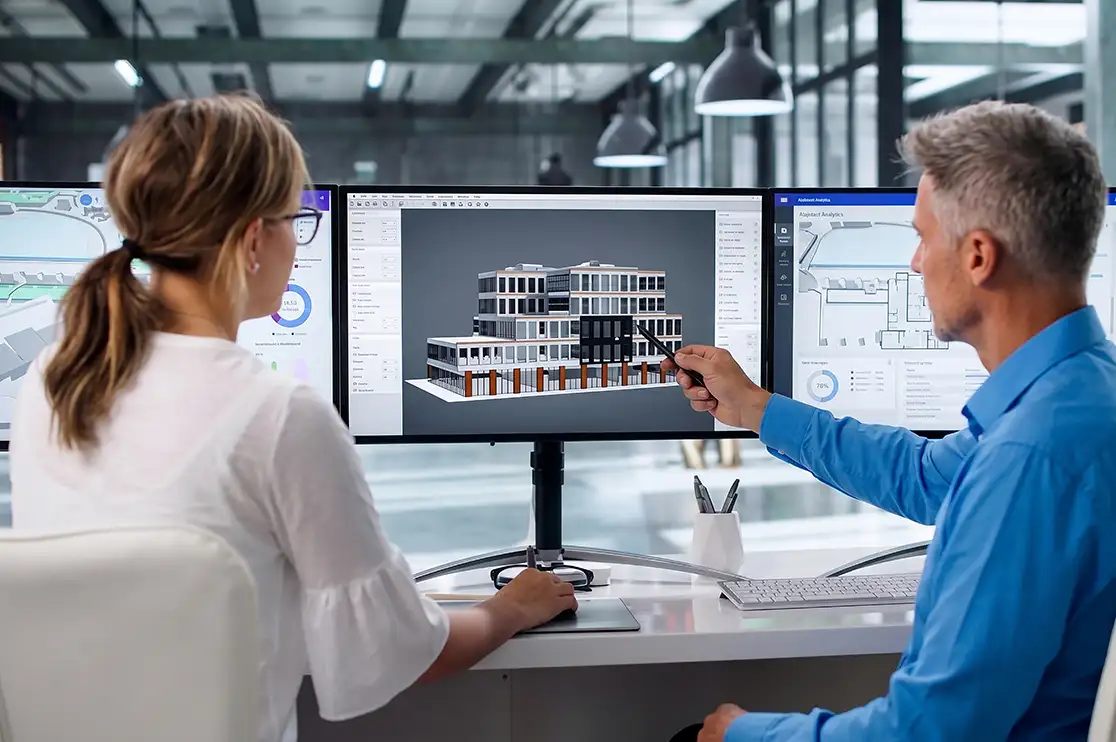
The GCs who outsource well set the rules before the first model changes hands:
-
Agree for a clash matrix. That’s a simple grid of which systems are tested against which, and how close is too close (the tolerance).
-
Set naming and grouping rules, so every report looks the same and is easy to scan.
-
Fix the deadline before each meeting: for example, a report was delivered the afternoon before.
-
Use one issue tracker that your team, the partner, and the trades all see.
-
Agree who updates after each meeting.
-
Keep the chair. Your coordinator runs the meeting; the partner supports.
-
Review weekly and fix process problems early.
If you also link the model to the construction schedule, the same partner can often support 4D schedule linking.
What should you ask for an outsourced BIM coordination partner?
-
Which software do you use for federation and clash testing, and which versions?
-
How quickly can you turn around a clash report after new models arrive?
-
How many hours overlap with our working day?
-
Have you worked on our type of building, or with similar trades?
-
Can we see a sample clash report and issue log?
-
Who will be our day-to-day contact?
-
How are our models and files kept secure?
The sample report is the most revealing. It shows whether the partner understands what your team needs on Tuesday morning.
More about how we support contractors: BIM for general contractors.
How is outsourced BIM coordination priced?
Usually one of two ways: a price per project or coordination phase, or a monthly rate for a dedicated coordinator supporting several projects.
Per project suits a defined coordination phase. A monthly rate suits a steady pipeline.
Ready to take the pressure off your VDC team?
If your coordinators are spending more time processing files than leading coordination, we can help. Every account gets a named coordinator as your single point of contact, and many clients start with a small pilot before committing.
Frequently asked questions
Can an outsourced team run our coordination meetings?They can join and support them, presenting clashes and recording decisions. But your coordinator should chair, because decisions about cost, schedule, and trade responsibility are yours.
Do we still need an in-house VDC coordinator?Yes, in most cases. Outsourcing removes the production load, not the need for someone with authority to lead coordination and make decisions.
How do we keep trades accountable if coordination is outsourced?The same way as now: through your meetings, your issue tracker, and your contracts. The partner prepares the information; your team holds the trades to it.
What do we need to share with an outsourced coordination team?Access to the trade models, your clash matrix and tolerances, naming rules, the meeting schedule, and the issue tracker. A confidentiality agreement should be signed first.







 What Drives the Cost and Timeline of a Scan-to-BIM Survey
 Pre-Contract vs Post-Contract BEP: What Each Must Contain
 BIM Staff Augmentation vs Project Outsourcing: Which Fits Your Team?
 BIM Pricing Models Explained: Per Sheet, Per Sq Ft, Hourly, or Fixed Price

